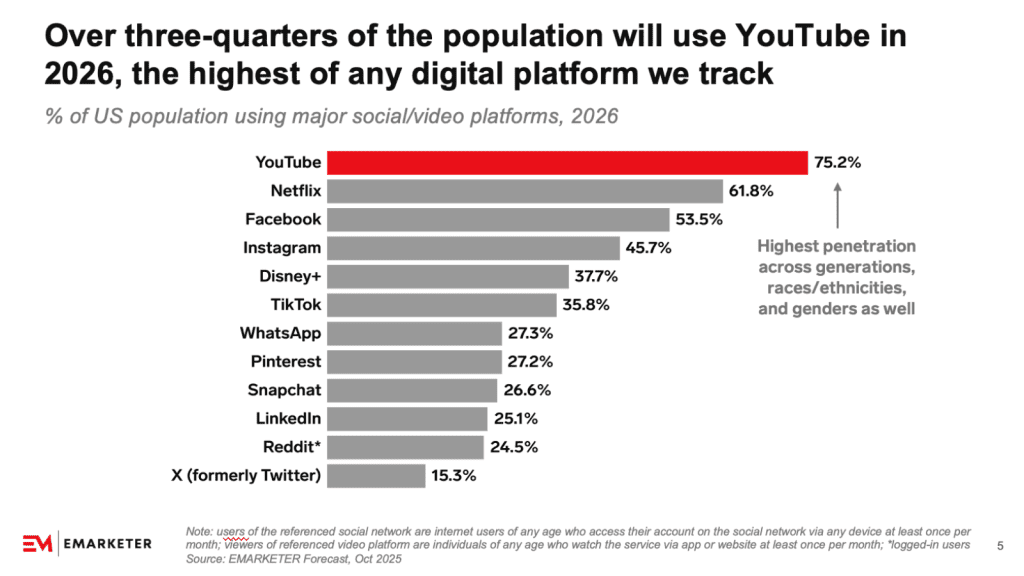
Jenny Bristow, CEO & Founder of Hedy & Hopp, is joined by Miranda Ochsner, Director of Paid Media to discuss the evolving landscape of YouTube as a critical platform for healthcare paid media. They highlight YouTube’s significant reach and unique advantages compared to other streaming and social platforms. With over 75% of the US population consuming YouTube content, it is the most-watched streaming platform on TV (surpassing even Netflix!) — making it a powerful platform for healthcare marketers.
Episode notes:
Strategic Advantages for Healthcare Marketers
- Patient Education & Discovery: Patients often use YouTube to research symptoms and self-diagnose before consulting a professional. Video content helps simplify complex medical topics and introduces expertise earlier in the patient journey.
- Targeting and Measurement: The platform combines the broad reach of traditional TV with the granular targeting and measurement capabilities of digital media.
- Content Versatility: YouTube can effectively host various video formats, including repurposed Facebook ads or traditional 30-second TV spots.
- Retargeting Capabilities: YouTube allows for “in-platform” retargeting that enables healthcare marketers to deliver content, such as a multi-part educational series, to the target audience.
- Paid and Organic Synergy: Paid media on YouTube can expand an organization’s reach to new audiences, while organic content builds long-term engagement.
Connect with Jenny:
Email: jenny@hedyandhopp.com
LinkedIn: https://www.linkedin.com/in/jennybristow/
Connect with Miranda:
Email: miranda.ochsner@hedyandhopp.com
LinkedIn: https://www.linkedin.com/in/mirandamochsner/
If you enjoyed this episode, we’d love to hear your feedback! Please consider leaving us a review on your preferred listening platform and sharing it with others.
Jenny: Hi friends! Welcome to today’s episode of We Are, Marketing Happy, a Healthcare Marketing Podcast. I am your host, Jenny Bristow, and I am also the CEO & founder at Hedy & Hopp, a full service, fully healthcare marketing agency. I’m very excited to be joined today by our very own Miranda Ochsner, who is our Director of Paid Media.
Miranda, thank you so much for joining us. Something we love to do on this podcast is make sure that we’re keeping our listeners up to date on the way the landscape is shifting, and you shared some really interesting information on some paid media landscape shifts, during our Monday Morning Huddle. So I asked you to hop on to be able to update our listeners because I found it so fascinating.
YouTube has always been a very important platform. Really if you think like the last decade of doing marketing, right, YouTube has always been up there. But there have been some recent shifts in the way that YouTube has shown up through the lens of paid media. I’d love to hear kind of your thoughts about it.
Miranda: Sure. So, you know, when, I think we all love a good video, but we have to make sure they’re, you know, in the right platform and aligning with our audience and kind of, you know, kind of their everyday behaviors.
So, YouTube is the second largest search engine in the world. I believe the stats, alone for the US were about 75% of the US population is consuming YouTube in some fashion. Strictly YouTube, not YouTube TV just YouTube, which is a huge like, that’s a lot, right? That’s a lot of people. And it’s, you know, digging into a little bit of the data on it.
We learned through some of our eMarketer research that it’s the most watched streaming platform on TV right now. So think of those big streaming platforms, and YouTube is at the top. You know, it’s beating out Netflix. It’s beating out Hulu. Like those are really large platforms with large reach and audience. But we have this unique opportunity with YouTube specifically because it’s not just a video platform, right?
Like this is where people are going to learn and research. And honestly, you know, we call it like “Doctor Google,” right? It’s they’re self diagnosing maybe before they even talk to a professional of like searching symptoms or “what should I be looking out for” or whatever. And that’s really unique because it allows the targeting and measurement of digital, but also the reach of TV at the same time.
So it’s not like your local, you know, TV broadcast where it’s like adults 25-54. Like we’re really getting to hone in and buying all of those channels together based off of those behaviors. With that unique reach.
Jenny: Yeah. When you shared that viewership of YouTube, excluding YouTube TV, has exceeded Netflix, that really blew my mind, because you always think about the big streaming monsters, right?
Like Netflix is number one in my mind. Yes. So it really was a very interesting fact for me that it officially has surpassed it. And we will actually embed these eMarketer stats that we’re talking about in the blog post. And we’ll try to do it in the show notes. I don’t know if we can embed an image or not, but if for sure, we’ll be on the blog post on the Hedy & Hopp website if you want to actually see the numbers for yourself.
But it is quite significant how much YouTube gets for viewership.
Miranda: Yep, YouTube, like looking at this right now and we’ll share it out, obviously. But YouTube’s at about 75.2% and Netflix, it’s like 60%. So that’s a solid 15% higher than Netflix. And then Facebook is in the 50s. So it is such a significant difference between those different platforms and how we’re utilizing them and whatnot.
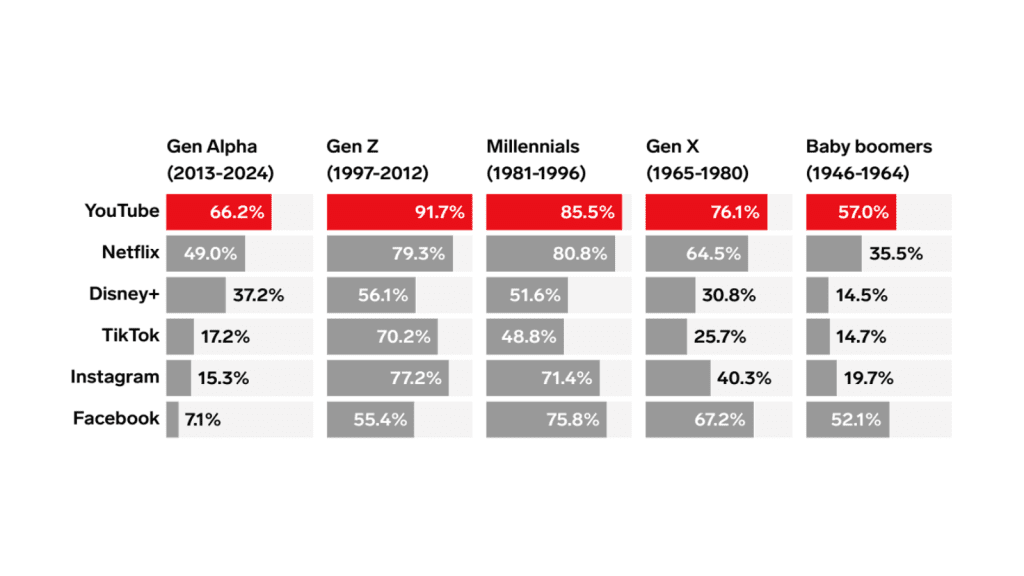
And what really makes YouTube so unique is this cross-generational reach. We also have this chart that we walked through, you know, looking from baby boomers to Gen A right now and the kind of really looking at that from, where they’re falling out within those streaming platforms. I’m looking I’m looking at the chart, our highest generations, if you want to call it that, for YouTube usage are Gen Z and millennials.
And that’s in the 90s, you know, low 90s, high 80s for Millennials. But we’re still above 55% for each one of those different generations. And then Netflix, Disney, TikTok, all of those fall underneath them. So it’s a really nice opportunity to hit cross generationally from a reach standpoint. But also where are they at within their journey?
You know, is it you know, healthcare is complex, right? We want to help, you know, simplify that a little bit if folks are doing their research and whatnot. So if they’re searching conditions, procedures, different options near them, whatever we want to be with, you know, we want to be with them on that journey and have a and have a video that’s able to connect with them and being able to hit them both younger and older is such a unique, just a unique approach from the standpoint of not every channel allows us to do that.
Jenny: Absolutely. And this chart where it broke it down by generation, was surprising to me about how massively YouTube beat out TikTok for, you know, Gen Z and Millennials. I again, and my head had some assumptions based off recent data, what I felt was recent data. So by last year or the year before about the acceleration of TikTok, and we have so many clients that are wanting to focus so much of their paid media dollars and really start thinking about that as a channel, but they aren’t even using YouTube yet, right?
So one of the things that we really try to push with our clients are thinking about media strategy is really understanding how we’re going to meet our patients, where they are based off the kind of content that we’re sharing with them. So while TikTok may feel like it is the next thing that you have to get on, it also requires a certain kind of video production.
Whereas with YouTube, you can repurpose different kinds of video that maybe feel more at home, like on Facebook or even more like a traditional TV spot, you know, like a 30 second or shorter that can live on YouTube and feel more organic. Whereas you could never do that on TikTok and have it feel in place at all. Right?
Miranda: And, you know, with YouTube, we’ve got these we’ve got these different approaches from a six second to a 30 second. I mean, it can keep going. We don’t ever push for too long of a video just because attention spans aren’t as long as they used to be on some of these. But there’s this teaser option, too, right, to get them to get them engaged a little bit more, or maybe take that next step, or if they see a 30, really watch the whole thing before they skip.
And there’s different ways that we can, really, just deploy from a link standpoint. But also, the fact is like they get to live on their YouTube channel, like you said. So organic and paid are working together, which is amazing, right? Like we want them working together in unison beautifully all together. And a lot of other platforms don’t offer that. That’s not even an option.
Jenny: And then another thing to think about, we covered this in a previous episode, but retargeting is dead in healthcare. The general concept of retargeting as a tactic. Right? Bur retargeting within platform, so thinking about YouTube, let’s say that we had a multi-part story or educational series that we need to educate folks on.
You can actually use retargeting within YouTube. So that way you can then share next episodes or a certain sequence to make sure that you’re delivering the content in the order that you want them to view it.
Miranda.It’s a nice spin on sequential messaging without retargeting.
Jenny: Exactly. Yeah, exactly. I love it. Let’s talk a little bit more about, how organic and paid can compliment each other on YouTube.
I want to share quickly, we did some work probably about five years ago with Saint Louis Children’s Hospital that I’m still very proud of, because what we did is we basically took the What to Expect When You’re Expecting concept and turned it into a social media concept. I love it, and, our point of contact that worked there at the time, in the marketing department actually got pregnant.
So we jumped on it and said, oh my gosh, let’s actually create a series where we can follow you along and we can introduce different providers, different procedures, kind of if you’re coming in for an ultrasound at your 20 week ultrasound, what does that experience look like? And really walk through and record it. And there were a bunch of tremendous successes organically.
As far as increasing viewership and subscribers and channel engagement, but was really interesting to me as we were able to repurpose that content, some of those videos being like two minutes long as an ad and people would watch the entire thing, or most of it before they did the skip button. So it’s very interesting to me of the different content types that you can try out, and the way that organic and paid can compliment each other on YouTube.
Miranda: And you can take those longer form videos, and to your point, snip them down a little bit and make it more of that multi series of what that kind of looks like and whatnot. But having that opportunity to, yes, organically reach and whatnot. But you know, they’re the paid side of it opens up a whole new lens of potential audience we might be missing.
Right? So with those two channel, sorry. Yeah. With those two channels working together, you’re maximizing your reach. And really hitting that audience that you want to hit all of the time.
Jenny: Yeah, absolutely, so as we’re talking about YouTube as a channel. Yes. And we’re thinking about CTV, OTT scale. How do you put YouTube in the overall consideration as we’re creating media strategies for our clients?
Miranda: That’s a great question. So, depending on the campaign. Right. Not video does not work for every campaign because of how goals and whatnot outlined. So we work really closely with our strategy team to truly understand, just like larger scale, what we’re trying to achieve, what those business goals. But from a from a media to how can media help support that?
So, depending on the campaign, we’ll jump into platforms like eMarketer or pull that research whatnot. But also, we, can pull from Definitive Healthcare as a platform that we utilize, and we can get really granular on different media habits, what they’re using, not using how often, what devices, all of the fun things that we media people can nerd out on.
And truly, you know, we really, truly understand who our patient is, what those behaviors are, what that makeup is, but also know it’s not going to be the same experience for every single person. But also when we recommend YouTube, if we’ve identified this is a really good fit, we know we’re looking at too from a paid search component because they’re all within that Google platform.
So how is the targeting working together while staying compliant? That’s a huge piece. Again, other platforms don’t always necessarily allow that. And you know, programmatically we can sometimes tie the data together. But also like there’s a nice little gray area on that that we have to be mindful of. But utilizing that, you know, from a keyword, content, custom audience build also with, the different custom segments within YouTube itself that we can layer on as part of that, like having those two work together is going to maximize our reach, maximize, you know, what that performance looks like.
Each channel has a different goal rate, but at the end of the day, it’s helping that larger media KPI that leads into that business goal.
Jenny: Perfect. Well, thank you so much, Miranda. I for our listeners, I know YouTube is not a new channel, right? This is a channel that we’ve had in our arsenal, but it’s 20, 25 years old at this point.
Miranda: I don’t know, I’m not that old, Jenny.
Jenny: I am! I’ve been in this industry for almost 25 years, and I think it’s been around as long as I have. So it’s been around this point.
Miranda:It’s been around 20 plus. Yeah. It has to be. Yeah.
Jenny: So I know that it isn’t something that’s always top of mind, but understanding how the viewership has really jumped up and where it falls in comparison with streaming channels and social media networks, hopefully will give you some additional consideration that if you’re not including it in your media mix, it’s something that you likely want to consider and start thinking about testing.
Because really, it is a big elephant in the room. Even though maybe it isn’t as sexy and exciting as thinking about something like TikTok or Snapchat or one of the newer ones. So. Well, thank you so much for joining Miranda. This is episode one of a little two part mini series we’re doing about media trends. So tune in next week when we’re going to talk about the shifting landscape and what to expect for the upcoming political season regarding media buying.
So thank you, Miranda, for tuning in. For our listeners, please, share this episode with any of your colleagues that you think would find it valuable. Please like and subscribe and we will see you on a future episode of We Are, Marketing Happy. Cheers.